Showing posts with label Farmer's Markets. Show all posts

Monday, March 16, 2009

Lviv and Being Resourceful

A few days ago Amy showed up at our apartment with the package of eggs you see below - cut to fit for six and tied together with the entrails of a cassette tape. She also had a Fanta bottle filled with raw milk. We'd walked past old timers selling it on the sidewalk and I hadn't even noticed that the bottles were being reused.


As a westerner it's tempting to read more than common sense and resourcefulness into this, maybe something in the spirit of the creative reuse noise emanating from Africa. That temptation has something to do with how hard pressed we are to accomplish basic behavior change in our own society. For me it also has something to do with how bats folks went at the Grand Lake Farmer's Market when vendors asked everyone to bring their own bags for Earth Day.

Ultimately a culture is either resourceful or not. Americans may be inventive and driven but this isn't the same thing. I submit as a kind of Exhibit B this tapestry at Lviv's Ethnographic Museum, the shiny bits of which are also cassette tape material. While examples of exactly this sort of material resourcefulness may abound in rural or economically depressed areas back home, Lviv isn't strictly speaking rural.


It's maybe obvious but still worth pointing out that being resourceful is no indication that a culture will stay that way. Last week I posted some photos of vegetables tied together with sewing thread. It's probably acrylic and who knows whether it's better or worse for the environment or you than rubber bands. But could you imagine a city of 700,000 in America where the majority of folks selling stuff from farm stands would have string enough on hand for it to make sense?

Sunday, March 15, 2009

Ramp Season in Lviv

Our stay in Lviv happened to coincide with the arrival of ramps. We noticed them for the first time a few days ago, invariably old women with huge bags full of little ramp bundles.

Not sure what the locals make of them. I heard a seller pitch them to a passerby other than us as lettuces. When Amy picked up today's batch another customer asked what to do with them. The woman selling them said that she disliked them and that people who bought them cooked them as they saw fit. Somehow this didn't deter the prospective buyer from requesting a couple of bunches, in response the woman selling them said that she'd be cooking them herself and should pick them out herself as well.

They were the real deal though. Very garlicky. Our pantry is pretty meager here, no olive oil even. When Amy asked me what I cooked them in I replied,"Bacon." Three bunches of ramps, a pound of pasta, three batons of bacon, and some peppercorns.

Monday, March 09, 2009

Another Market - Lviv, Ukraine

Yesterday we schlepped over to a train museum that turned out to be closed. We licked our wounds in a cafe alongside this market. We'd walked for half an hour at this point and the espresso, cake, and buttered toast with cured fish were very welcome. The guy one table over had more or less the same and supplemented with a vodka shot.

A cold or wet morning will more or less wipe out the weekly markets back home. This daily market was humming along with six inches of snow on the ground and a stiff wind ripping through the flimsy umbrellas. Apples looked amazing in all that snow. We got four cucumbers, half a squash, three potatoes, a few bananas, 500 grams worth of clementines, and the leeks and turnips for about three bucks.


Amy lugged Axel around on her back. In exchange for this service I carried her China Town Batz-Maru purse.


Through our first few days here, the only green things I ate were parsley and dill. We waited a long time for these cucumbers, while the woman in front of us bought a big bag of grapes. The vendor picked out each of the bad ones.


Every meal we've eaten, whether at home or our and about has been served on this scalloped white place setting. The Krakow Cafe, a fast food pizza place, and the cafe yesterday.


I mentioned the herb bundles tied together with sewing thread, but turns out bundles of jut about everything are tied together with it.

Sunday, March 08, 2009

Strysky Market - Lviv, Ukraine

Getting my sea legs after two days of travel. I've thrown together a blog to capture all of my navel gazing about our trip to Lviv, but will still be posting food-related items here. Long time readers will wonder why the heck I've somewhat customized this new blog and still intermittently plug away in the minima template here. A good question which might be in need of an answer this year. In the mean time, some shots from the market we've been frequenting.


This sign reads Strysky Market. The market sits at the bottom of a hill where Strysky Park begins.


The market is housed in a permanent structure that's flanked along one side by flower stands and a guy who sells fresh fish from a truck - just like those ladies at the Old Oakland Friday market.


Inside the walls of the market there are permanent stalls for dry goods, toys, you name it. Some of the food vendors occupy these as well, but most of the action is on long tables. The box of what looks like gelatinous blood is actually a tasty apricot paste. More wet than membrillo but the same idea.

Sunday, October 21, 2007

Looking for Apples In the East Bay?


If apples are your thing, head to the Jack London Square Farmers' Market and find Joe Stabile's Hillview Farms stand. Tell them whether you're looking for a tart or sweet apple, a cooking apple or out of hand apple, and then take their advice. They grow 200 varieties, many of the heirloom or antique, and I've been blown away by the 6 I've tried. I say this as a life-long citrus fan.

As a child, my lunchtime fruit was almost always some type of orange. Oranges were not necessarily a choice, I went shopping with my mother infrequently once school started. But, I had a preference for them over apples - the other school yard fruit option. It's worth pointing out that we're talking about conventional, grocery store fruit here. Purchased at the nearest Ralph's, available year round and with very little positive variation in taste.

During college I began to like Fuji Apples. They were the first apple I encountered that was not a red delicious, yellow delicious, granny smith, or pippin. Over the last couple of years, I've been exposed to a lot more apple varieties. I picked up my first Arkansas Black at Berkeley Bowl, Sun Downer and Pink Lady too. I'm always happy to see Crimson Gold when they start showing up, but I have not looked forward to them.

Last month we wound up at the Jack London Square market by accident. There were a lot of prepared food stands, some farmers that we shopped from at the Grand Lake market, and then there was the Hill View farms apple stand.

These apples were immediately recognizable as things that grew in a real place with weather, and most of them had names I'd never seen before. He had Thomas Jefferson's apple of choice the Esopus Spitenzberg, red-fleshed apples like the Hidden Rose and Pink Pearl. Last week I grabbed some Jonathans and Winesaps. Less exotic than the red-fleshed Hidden Rose, but more complex and delicious than any apple I'd ever eaten.

So, all things being equal, given the choice between an apple and an orange - I'll go with the orange. But my conversion to a seasonal produce shopper means there are at least two months where that's a choice I don't have to make.

Photo credit: Len Vaughn-Lahman / Mercury News

Tuesday, June 05, 2007

Farmers Raving About This Year's Stone Fruit

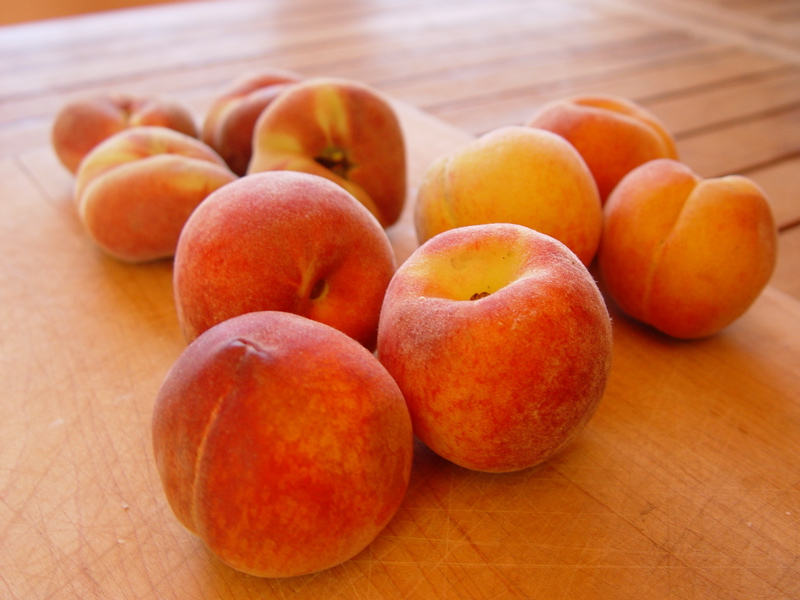
My intention with this post is to encourage all of your Nothern Californians to find your way to a famer's market this week and buy some cherries, some apricots, basically any fruit with a pit. My assurances that tasty stone fruit were there for the taking last year were based on a lifetime of experience eating grocery store fruit, and a concerted few years of eating farmer's market fruit.

This year's fruit blows last year's away to a startling degree. Startling that is, unless you happen to be a fruit farmer. In which case you probably know that the last couple of years have been good but not great, or maybe even okay but not really good. If you've only recently acquired serious food religion, this is the sort of thing you can't know.

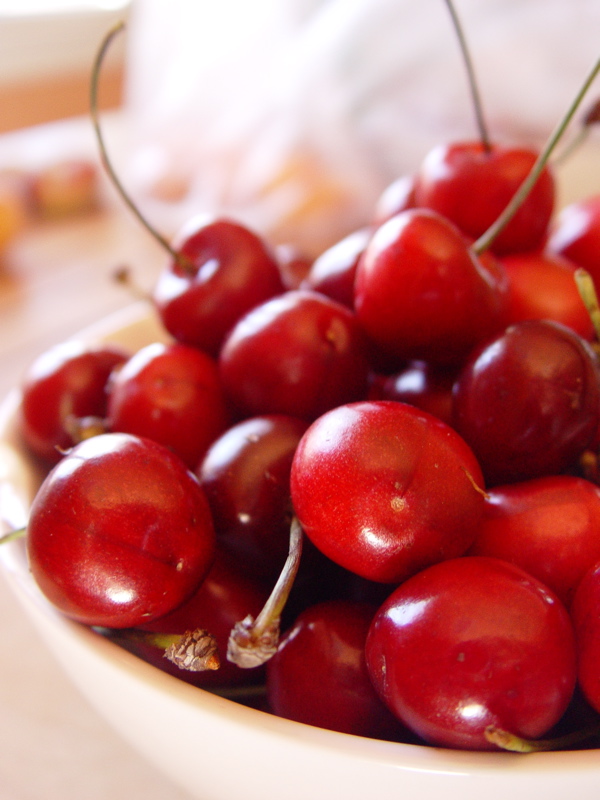
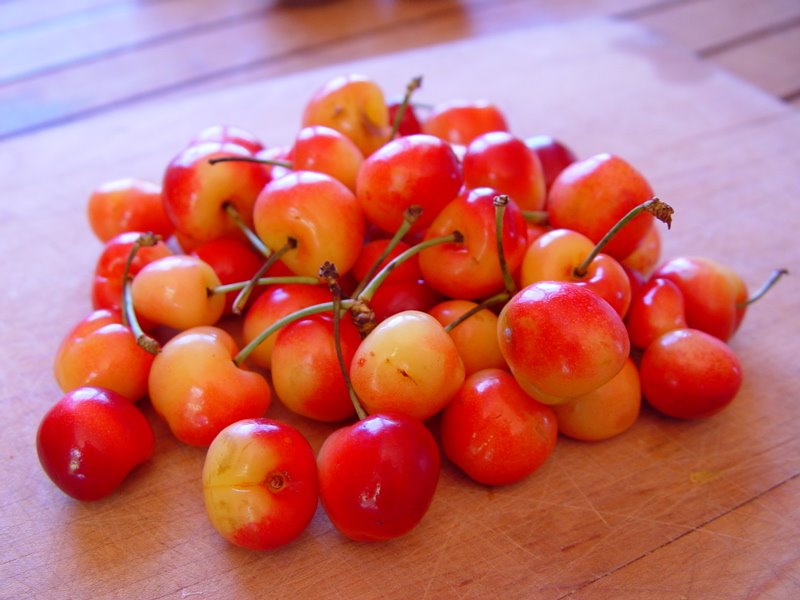
Two Saturdays ago I was surprised to see the Wild Boar Farms booth at the Grand Lake Farmer's Market decked out with cherry tree boughs. I asked Brad if he'd had cherries last year, and he said that he only got a crop every two or three years - when the conditions were just right. As I grabbed a sample cherry, he had Bings and Rainiers, a woman who was arranging to have a case of them delivered to her restaurant offered up that they were the best she'd ever tasted.


This past weekend I stopped by the Lagier Ranches booth and made small talk about how well cherries seemed to be doing. The guy working the stand bellowed,"Finally!" He went on to say that he expected it to be a great year for all stone fruit. As service-oriented as anyone I've ever encountered at the market, he went on to offer to "call John" to find out when Sour Cherries would be available.

It's not just cherries either. One of the guys at the Blossom Bluff Ochards stand, described the taste of their apricots as completely out of left field. I had sampled the fruit and wasn't completely convinced, but there I was at work yesterday looking at a puddle of apricot juice on my desk - unsure of whether or not I could resist slurping it up.

Incidentally, I did not have the guy working the Lagier Ranches booth ring John Lagier at 9:30am on a Saturday morning. Probably the surest sign that I am not cut out to be a high profile food blogger.

Saturday, May 19, 2007

Interview with Brad Gates of Wild Boar Farms

Chez Panisse Vegetables pegs bay area tomatoes as a late summer phenomenon, but I wasn't hooked on Wild Boar tomatoes until my first taste of an Evan's Purple Plum in October of 2005. Like any self-respecting internet professional, I headed to Google to see what I could find out about the source of these intensely flavorful tomatoes. I couldn't find out much, other than that Brad Gates also sold lilacs. Of the three reference guides I have consulted, all maintain that it is not advisable to grow lilacs in the Bay Area.1

Last year, unable to find an email address to send my well wishes, I printed up the handful of blog entries I'd posted on Wild Boar tomatoes and dropped them off at Brad's farm stand. Over the months that followed we struck up an email correspondence that exposed me to several online outposts of the tomato cult, revealed that Brad had been meaning to look into the Slow Food movement but hadn't yet, and that (all my ramblings aside) terroir wasn't really on his mind."Is that a dog breed?", he asked.2

None of which is too surprising when you consider that Wild Boar Farms, and its six thousand tomato plants, are largely a one-person operation. Brad does hire one person to help him out during the picking season and has been known to bribe his kids to help out, but otherwise from January to November he's the primary care giver for all those plants. When I dropped by the farmer's market on May 19th, he described the previous work day as having started at 5am and having wrapped up at midnight. I think I replied something like,"Oof." To which he responded,"You've gotta cast your net while the grunion are running."3

This year it shouldn't be quite so difficult for folks to get the goods on Brad and his farm. He recently launched an online store for his seeds, and is hard at work on a website. He also agreed to this interview, which we conducted in April. Given how infrequently I've been able to post this spring, I suppose the editorially shrewd thing to do would be for me to break it up over a couple of weeks, but the content doesn't really lend itself to doing so. So here, in it's entirety, is my interview with Brad Gates of Wild Boar Farms.

How did you get started with tomatoes?
I worked for a summer selling tomatoes for a friend at farmer's markets. I was doing landscaping at the time, because I love plants and love to be outdoors. People are not that appreciative when you do landscaping work for them but people kept thanking me for bringing them tomatoes.

Where is Wild Boar Farms located?
I farm in the Suisun Valley in Solano County. I have grown tomatoes in three counties, Napa, Yolo and Solano. Yolo is nice for real early tomatoes but to blazing hot in the summer, Napa is great for grapes but not quite as warm as tomatoes like, so my best tomatoes came from Suisun and I stayed.

The soil is unbelievable also, I grow on class I soil (the best). Places with 10 feet of topsoil are considered excellent, Suisun Valley has topsoil that is almost 100 feet deep thanks to receding glaciers that shaped the region.


Restaurants serving Wild Boar Farms tomatoes

Brad sells his tomatoes to distributors and re-sellers who supply many local restaurants. He sells directly to the following Restaurants
:


What do you figure the climatic variables are for the flavor of your tomatoes?
I have noticed that some varieties do good no matter if it is cool, hot or whatever. So, I may have to rely more on those varieties. Water control is also very important in tomato flavor.

You and I talked a few times about how whacky the weather was last year, in your experience is there such a thing as a typical growing season in the bay area?
I have been growing for ten years and the last two where the most challenging with last year taking the crown. Soaking rains till May and three weeks of 100-115 degree temps for three weeks straight are not what made California a produce mecca so lets hope that does not happen again for a long while.

In our conversations about what you do, you've mentioned colleagues from around the world. Is there a perception on the part of these folks with regards to climate change?
I have noticed people from other parts of the world mention odd weather. I know that in at least parts of New Zealand they did not even get summer this year. I heard of 50 something day tomatoes taking almost 100 days.

How many varieties of tomato plants do you grow each year?
I have grown 50-100 each year. Some of the varieties I am working on that are unstable may give me 50 different tomatoes, thats just from one working variety so thats a lot of tomato variables. I have made many trades from around the world this year so I am adding over 100 new trial varieties to the 100 or so I was already going to grow.

Two years ago my wife and I were all about your purple plum tomatoes. Last year it was the Berkeley Tie Dye. Do you find that a given variety changes much from year?
There are so many variables that, yes, the flavor can even change day to day. But there are other factors, like when you first tried Evan's Purple Plum I think it may have been late in the season, well that variety hangs on the vine well late season and takes on a rich flavor that usually only shows up in October. It's is a stand out flavor that very few have ever experienced. Berkeley Tie Dye does great mid season but does not like to much cool weather and does not hang on the vine so I have learned to plant different varieties at different times.

Do you have a personal favorite?
Too many good tomatoes, well, Pink Berkeley Tie-Dye.

You turned me on to Tomatoville.com, and you recently began selling your seeds online. How has the internet influenced what you do?
There is a lot to learn from a cult tomato group like Tomatoville.com. Always hearing about new varieties, seeing how people react to your varieties, sharing varieties around the world, endless ideas.

As near as I can tell, you and other members of the tomato cult gather for a mid-summer tomato tasting. Can you describe the sorts of tomatoes that show up at these events?
Actually I have missed my local tastings because they have been held on Saturday's. Every Saturday is spent selling tomatoes. So this year I am offering to have the tasting at my garden on a Sunday so I can go.

You've described a few of your varieties as being basically unique. I'm thinking of Brad's Black Heart and the various 'furry' tomatoes. Can you describe the process of arriving at these one of a kind tomatoes?
A lot of them have been lucky finds which I attribute to growing tens of thousands of plants and actually being the one going up and down the rows doing the work to notice them. Once you find something unique with a lot of plants to choose from you can get some pretty bizarre looking tomatoes, the key is selecting for flavor to go along with that unique look.


Places you can buy Wild Boar Farms tomatoes:

In addition to yourself, I'm a big fan of Prather Ranch, Lagier Ranches, and County Line Harvest. Are their other farmers whose work you admire?
That's a tough one, because I do not get a chance to really get to know to many other farmers and see what they are about. Probably the smaller they are the more I admire them. The bigger they are, the more likely they are to promote bad labor practices and unfair pay for hard core work. The one employee I have I pay almost twice minimum wage which is a lot more then anyone else I know in this business. I admire anyone actually doing the farming.

Anything else you'd like to say?
Support small farmers - buy local and in season for the best tasting, most nutritious produce.


Footnotes

1
At the very least, growing lilacs here is considered challenging. Sunset's Western Garden book refers to the Bay Area as Zone 15, and says it is possible to grow them here despite their preference for decidedly chilly winters. In addition to the climatic challenges posed by our mild winters, Sunset also warns against leaf miner, scale and stem borer. Brad agrees that conditions are not optimal, but maintains that, "If you grow lots of varieties and lots of plants you will get some nice blooms." It's worth reinforcing that this philosophy isn't so different from how he approaches tomatoes.

2 Compare this to the folks at Knoll Farms, who promote their brand of 'organismal' farming under a folksy abstraction of terroir ( Tairwa´).

3 An informal survey of several friends and family members suggests that, particularly in the context of agriculture, this is a relatively obscure reference. I'll provide a link to the Wikipedia entry for grunion and let you draw your own conclusions. However, I will also take a moment to point out that Brad has a particular way with words. One weekend he brought several mature Tomato Horn Worms with him to the Farmer's Market. In response to multiple squeamish inquiries, he offered up,"I usually just squash them, these worms don't have it so bad - making the trip down to Oakland and getting to spend time with all of you nice people."